
Xiaomi Unveils The Redmi Note 3, Its First Phone With A Fingerprint Scanner


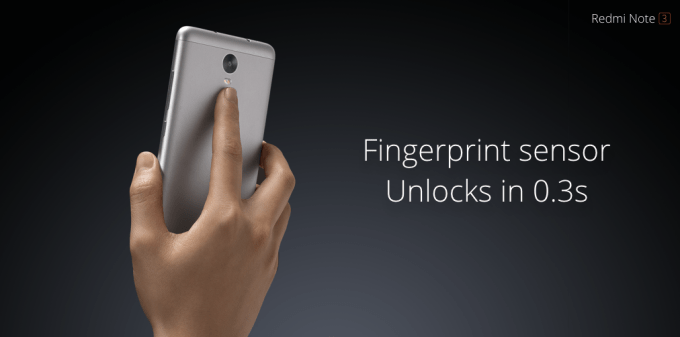
Increasing the focus on its nascent payment service, China’s Xiaomi has brought a fingerprint scanner to its range of affordable smartphones for the first time after it unveiled the third-generation Redmi Note in Beijing today.
The sensor, which is located on the reverse of the Redmi Note 3, is the most striking feature of the new 5.5-inch phablet, which will retail for 899 RMB ($140) and will initially debut in China. Also of note, the phone comes with a metallic body for the first time while Xiaomi has increased the device’s battery to a whopping 4000mAh capacity.
Under the hood, the phone is powered by a Helio X10 chip from MediaTek. It comes in at 8.65mm thick and, at 164g, is 4g heavier than the previous Redmi Note 2, which was unveiled just three months ago. The Redmi Note 3 also includes the same 13-megapixel front camera and five-megapixel rear camera as its predecessor.
Screenshot 2015-11-24 13.44.09
This device is likely to be the first of many from Xiaomi to get a fingerprint scanner, but its unveiling today marks Xiaomi’s step into the payments space in a potentially major way. While the sensor can be used to unlock the phone without a passcode, like those on devices from other companies, that’s just the start.
Back in July, Xiaomi fully released Mi Wallet, a new feature that goes beyond services like Apple Wallet or Apple Pay to allow payments, bank account management and other financial services for Xiaomi device owners. Now, Xiaomi is widening the base for the mobile payment service that could be an important part of Mi Wallet.
The basic Mi Wallet service is available worldwide, but some specific elements — for example mobile payment — are limited to China for now. Given that Xiaomi sold 60 million devices last year, and it is aiming to reach 80 million this year, its entry into mobile payments could be hugely significant.
(Interestingly, just hours before this launch event, sources leaked Apple’s plan to launch Apple Pay in China by February. Coincidence? Just maybe.)
Xiaomi wasn’t quite done there for today, though.
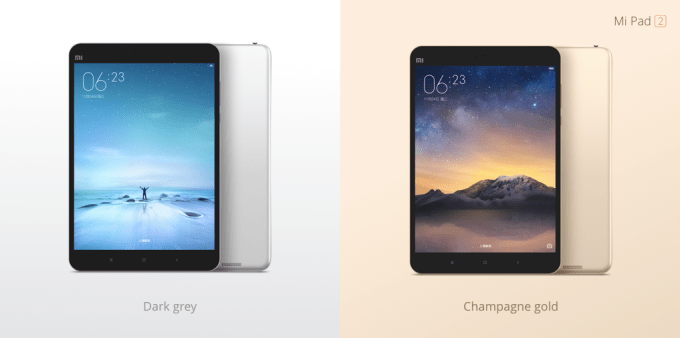
The firm also unveiled its second generation tablet, the Mi Pad 2. Now with a full metallic body, like the Redmi Note 3, Xiaomi said the new Mi Pad is 18 percent thinner and 38g lighter than the previous model. Oh, and it comes in a new “Champagne Gold” color option, too.
Screenshot 2015-11-24 13.43.16
In more detail, the Mi Pad has shifted over from its previous Nvidia internals, with the gen-two model powered by an Intel Atom X5-Z8500 processor with an Intel Atom 64-bit CPU. It has a 7.9-inch display, eight- and five-megapixel cameras on the back and front, and a 6190mAh battery. It also supports USB Type-C port.
The Mi Pad 2 is priced at 999 RMB (around $155) or 1,299 RMB (around $200) for 16GB and 64GB models, respectively. Interesting, the larger 64GB version will also be available as a Windows 10 device from next month — making it a fairly inexpensive entry point to Microsoft’s latest operating system.
And finally, because good things come in threes sometimes, Xiaomi announced the second generation of its ‘smart’ air purifier, which first launched in December. Version two is lighter and smaller, the company claimed.

Comments

Popular posts from this blog

Peel Turns Your Apple Watch Into A Universal Remote Control

Does it make sense to use your Apple Watch as a remote control for your media devices? Smart remote maker  Peel  thinks so, having just launched a universal remote control application for the Apple Watch which lets you operate over 400,000 models of home electronics, including not only televisions, but also DVD players, and even audio and streaming devices, like the Roku. The Apple Watch app is actually an extension of the company’s  existing smart remote app for iPhone . And while in a few cases the new Watch app will allow you to control your devices via Wi-Fi, for the most part, it will require the  Pronto  hardware just like the iPhone version does. The Pronto 360-degree IR blaster is what turns the iPhone, and now the Apple Watch, into a smart universal remote control. A $49.99 piece of hardware about the size of a salt shaker, Pronto sits in your entertainment center to provide the IR capabilities required to operate your TV and other electroni...

Intel announces the first 14 nanometre processor

At the Computex conference in Taipei, chipmaker Intel has revealed a fanless mobile PC reference design using the first of its next-generation 14nm "Broadwell" processors. The 2 in 1 pictured here is a 12.5" screen that is just 7.2 mm thick with keyboard detached and weighs 670 grams.  The Surface Pro 3  – for comparison – is 9.1 mm thick and weighs 800 grams. It includes a media dock that provides additional cooling for a burst of performance. The next-generation chip is purpose-built for 2 in 1s and will hit the market later in  2014 . Called the Intel Core M, it will be the most energy-efficient Intel Core processor in the company's history with power usage cut by up to 45 percent, resulting in 60 percent less heat. The majority of designs based on this new chip are expected to be fanless, with up to  32 hours of battery life,  offering both a lightning-fast tablet and razor-thin laptop. Intel is also delivering innovation and performance for the ...

Google, Microsoft, Mozilla And Others Team Up To Launch WebAssembly, A New Binary Format For The Web

Google, Microsoft, Mozilla and the engineers on the WebKit project today announced that they have teamed up to launch WebAssembly, a new binary format for compiling applications for the web. The web thrives on standards and, for better or worse, JavaScript is its programming language. Over the years, however, we’ve seen more and more efforts that allow developers to work around some of the limitations of JavaScript by building compilers that transpile code in other languages to JavaScript. Some of these projects focus on adding new features to the language (like Microsoft’s TypeScript) or speeding up JavaScript (like Mozilla’s asm.jsproject). Now, many of these projects are starting to come together in the form of WebAssmbly. The new format is meant to allow programmers to compile their code for the browser (currently the focus is on C/C++, with other languages to follow), where it is then executed inside the J...

Barnes & Noble is killing itself

I’ve been chronicling the slow demise of B&N for years now, watching the company bleed out, drop by drop, until it has become a shell of its former value. B&N was a cultural center in places without cultural centers. It was a stopover on rainy days in New York, Chicago, and Cleveland and it was a place you could go to get your kids’ first books. That’s mostly over now. On Monday the company laid off 1,800 people. This offered a cost savings of $40 million. But that’s particularly interesting. That means each of those people made an average of $22,000 or so per year and minimum wage workers – hourly folks who are usually hit hardest during post-holiday downturns – would be making $15,000. In fact, what B&N did was fire all full time employees at 781 stores. From a former employee: On Monday morning, every single Barnes & Noble location told their full-time employees to pack up and leave. The eliminated positions were as follows: the head cashiers (those are the pe...

How to Install and Uninstall Graphics Tools in Windows 10?

Windows 10 has included some optional features which are in-built in the operating system but not installed by default. The Graphics Tool is one such package. The Graphic Tools are needed for users who use Visual Studio to develop DirectX apps or games. The tools have many utility like Graphics debugging, tracing Direct3D calls, inspection of parameters, analyzing Direct3D calls, experiments with shaders and many more. Visual Studio has a Graphics Frame Analysis tool that operates on graphics debugging log. It also collects all necessary information to draw Direct3D calls. The Graphics tools also consist of GPU Usage which lets you analyse and track GPU use in real time and at the same time collects and analyzes the timing data of the workloads. Steps to Install and Uninstall Graphics Tools in Windows 10? 1.  Open the Start Menu, go to  Settings  and tap on  System . 2.  Go to  Apps and features . 3.  In the right panel, tap  Manage ...