Pre-Orders For The New Apple TV Are Now Live


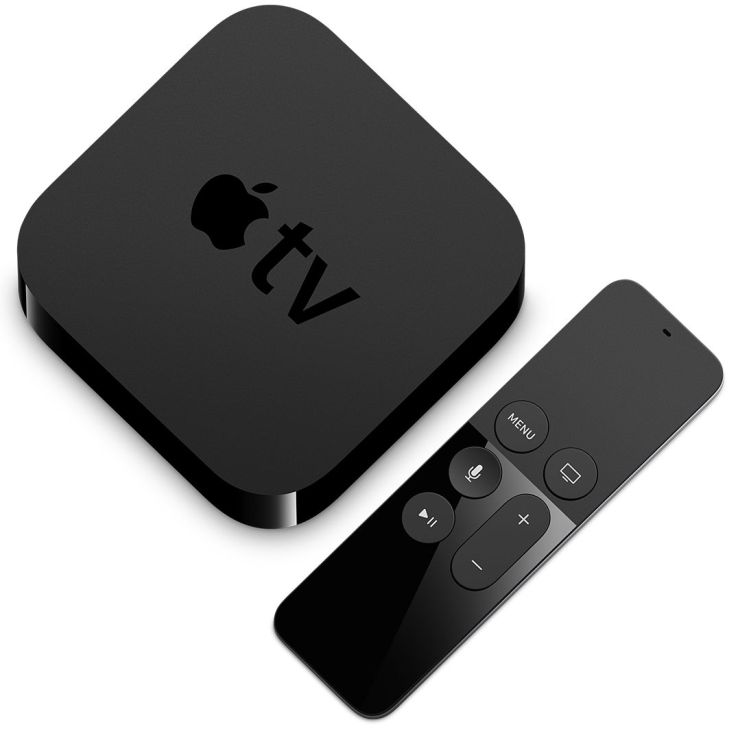
As promised by Apple CEO Tim Cook last week, pre-orders for the new Apple TV have begun today. The new device, which is the first to feature an App Store for third-party applications and games, as well as a new touched-based remote, and Siri integration, is available in two different storage capacities. The 32 GB Apple TV is $149, while the larger 64 GB version is $199. The first orders will begin shipping on October 30th.
This fourth-generation Apple TV is available for order in 80 countries, though Siri support will be limited to around a dozen.
Included in the box are the Apple TV and remote, as well as a lightning-to-USB cable and power cord. Apple is also selling additional Siri remotes for $79 and extra “Remote Loops” (aka wrist straps) for $12.99. AppleCare coverage for the new hardware is $29.
The remote control is one of the device’s more interesting features, as it lets you do things like fast-forward and rewind by pressing on the touch-sensitive trackpad. And you can also move it around to control games, thanks to an included accelerometer and gyroscope. For more serious gamers, the new Apple TV also supports MFi-based third-party controllers.
That addition, alongside the long-anticipated Apple TV App Store should make Apple’s streaming media player more competitive with others on the market, including Amazon’s Fire TV, Android TV, Roku and others.
On the software side, the Siri support paves the way for features like universal search by voice. That means you can search for titles using more natural language queries, like “Show me movies with [a favorite actor’s name],” e.g. the Apple TV can return results from the iTunes App Store and Apple Music Library, in addition to online services like Netflix, Hulu or HBO.
The hardware itself is also more powerful, as it includes the A8 processor – the same one that ships in the iPhone 6 and iPhone 6 Plus. Though not the same one that comes with newer iPhones (the 6s and 6s Plus), it’s still a big upgrade over previous generations. It additionally offers support for H.264 video up to 1080p at 60 frames per second, plus 802.11ac Wi‑Fi, Ethernet and Bluetooth 4.0.With a growing number of streaming services, universal search is now a must-have feature for any streaming media / connected TV player today – and one that Apple TV competitors, as well as DVR makers like TiVo, have offered for some time.
Though the fourth-gen Apple TV is now available, Apple hasn’t yet phased out the older model. The third-generation device is still for sale, too, at $69.00.

Comments

Popular posts from this blog

IT Where

#Responsive_Webdesign  start from #7500, #hosting_Service  Start from #3300 Per Year #get   #your   #special  offers at  Itwhere Pondy #Digital_Marketing  , #SEO , #Product_Branding  at Itwhere Pondy Email:info@itwheretech.co. in M:+91 9092734853 www.itwheretech.co.in

Google Announces Android Wear Update With WiFi Support, Always-On Apps, And More

It has been a while since Android Wear got any substantial updates, but today Google is announcing a big one. A new version of Wear will be rolling out over the coming weeks that includes a number of previously rumored features (like WiFi support) and some all new stuff (like always-on apps). Most Wear devices use the always-on ambient mode for the watch face by default, the Moto 360 being a notable exception. The new Android Wear version allows apps to operate in ambient mode too, so they remain active when the watch goes to sleep. That makes it easier to take a quick glance at the app instead of waking the device up and opening the app all over again. The watch will still only go into full-color mode when necessary. WiFi support is also coming in the update, which means your watch can be useful even if your phone isn't connected. Watches with WiFi support will be able to connect to WiFi and still get messages and notifications from your phone, provided it has an interne...

Top 20 WordPress Interview Questions and Answers

Top 40 WordPress Interview Questions and Answers  for freshers and experienced are below are below : 1. What is WordPress? WordPress is an online, open source website creation tool written in PHP. But in non-geek speak, it's probably the easiest and most powerful blogging and website content management system (or CMS) in existence today. 2. Different between WordPress.com vs WordPress.org? WordPress.com (fully hosted) Focus on your beautiful content, and let us handle the rest. WordPress.org (self-hosted) Get your hands dirty, and host your website yourself. refer official URL: https://en.support.wordpress.com/com-vs-org/ for more details. 3. Use of WordPress? WordPress is a free and open-source blogging tool and a content management system (CMS) based on PHP and MySQL. Features include a plugin architecture and a template system. WordPress was used by more than 23.3% of the top 10 million websites as of January 2015 4. feature of WordPress? Here are some of the featu...

Phoenix OS is (another) Android-as-a-desktop

Google Android may have been developed as a smartphone operating system (and later ported to tablets, TVs, watches, and other platforms), but over the past few years we’ve seen a number of attempts to turn it into a desktop operating system. One of the most successful has been  Remix OS , which gives Android a taskbar, start menu, and an excellent window management system. The Remix OS team has also generated a lot of buzz over the past year, and this week the operating system gained a lot of new alpha testers thanks to a  downloadable version of Remix OS  that you can run on many recent desktop or notebook computers. But Remix OS isn’t the only game in town.  Phoenix OS  is another Android-as-desktop operating system, and while it’s still pretty rough around the edges, there are a few features that could make it a better option for some testers. Some background I first discovered Phoenix OS from  a post in the Remix OS Google Group , altho...

The App Ecosystem’s New Status Quo

Americans spent more time using smartphone and tablet applications in 2014 than they did mobile and desktop web combined. With  nearly four billion smartphones projected  to be in use by 2020, the platform shift to mobile is well underway. The smartphone supply chain has already become a central and unifying aspect of the tech industry. For the first time, there exists a ubiquitous technology that connects us all to a central ecosystem, and apps form a huge part of this. The bar is constantly rising for mobile, and if we accept the “mobilization” of the future as a given, then what we are seeing is only just the very beginning.   Paradigm shift in payment models Many people still view apps as unsophisticated software with simple, one-dimensional functionality. This perception, however, is going to change. With the widespread adoption of mobile devices and the continued improvement of the hardware layer, alongside the creation of a robust app economy, it has bec...