
Google Launches OnHub Router, Promises Faster Wi-Fi And Simpler Setup

Google today surprised us by launching a router with the help of its partner TP-LINK. The $199.99 OnHub router promises to do away with many of the issues you’ve likely experienced with your existing router: Wi-Fi slowing to a crawl, videos buffering and connections randomly dropping out. That always meant unplugging the device, waiting a minute or so, plugging it back in, and then hoping for the best.
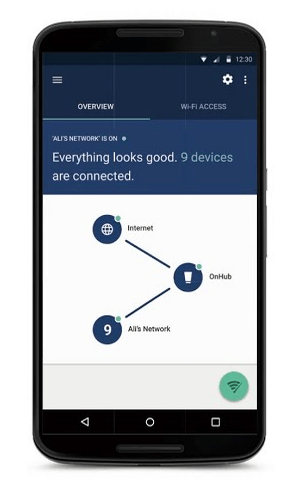
Screen Shot 2015-08-18 at 9.41.42 AMGoogle promises the OnHub router will “give you Wi-Fi that’s fast, secure, and easy to use.” The company says setup is easy and the device automatically scans your local airwaves to find the best channel for you. “A unique antenna design and smart software keep working in the background, automatically adjusting OnHub to avoid interference and keep your network at peak performance,” Google says.
The router will also automatically install updates and new features as they are released.
Unsurprisingly, the router is controlled by a single mobile app that can run on Android and iOS. From there, you can manage all of your devices and check up on your network. You can also use the app to quickly send your WiFi passwords to your friends.
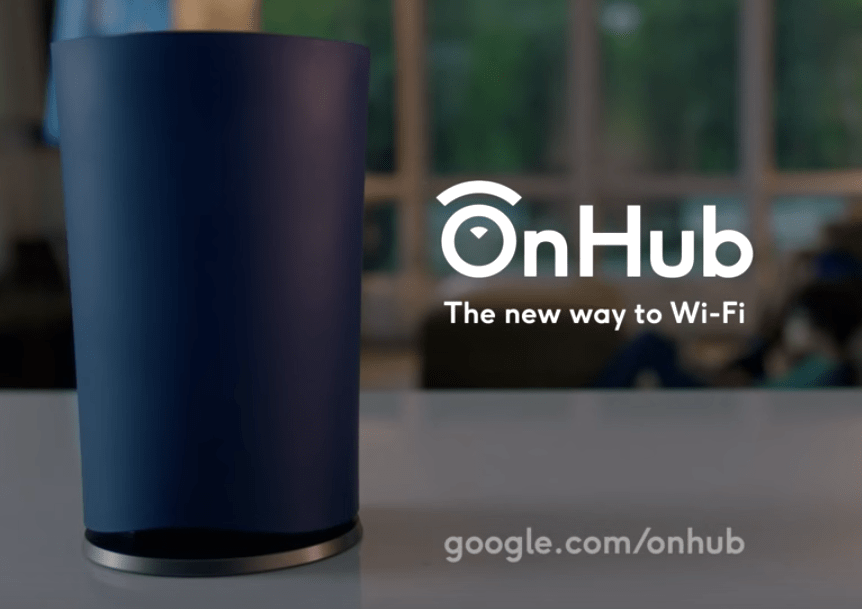
Unlike similar devices, the router is actually also nicely designed and looks a bit more like the ill-fated but beautiful Nexus Q than your standard Netgear equipment.
The new router is now available in the U.S. on the Google Store, as well as at Amazon, and Walmart.com. It’s also coming to retail stores in the U.S. and Canada soon. Google says it will soon launch a similar device with ASUS, too.
Screen Shot 2015-08-18 at 9.44.51 AM

At almost $200, OnHub is definitely a bit of a luxury item, so it remains to be seen how well it will sell. If anything, though, it will hopefully give other router vendors an incentive to step up their game. For what it’s worth, Apple’s AirPort Extreme clocks in at a similar price point, but it’s been two years since Apple launched the 6th generation of this product.

Comments

Popular posts from this blog

Visa confirms Coinbase wasn’t at fault for overcharging users

Yesterday, we wrote that Coinbase customers were being charged multiple times for past transactions. While some speculated that the erroneous withdraws were down to a Coinbase engineering issue, Coinbase issued a statement saying it wasn’t liable for the duplicate charges. The blame, instead, rested with Visa for the way it handled a migration of merchant categories for cryptocurrencies, Coinbase said. While you can read my post yesterday for an in-depth description of what happened, the basic gist is that Visa refunded and recharged (under a different merchant category) a month of old transactions. Many users saw the recharge come through before the refund processed, making it look like they were double charged. Honestly, the issue was likely exacerbated by existing payment rails — it’s normal for refunds to take multiple days to show up on credit and debit statements. But here’s where it gets weird — this morning Visa issued a statement to some publications shifting the blam...

Here’s how to keep track of Elon Musk’s Roadster and Starman in space

Elon Musk’s Starman, the mannequin driver of the Tesla Roadster SpaceX launched aboard its Falcon Heavy rocket, is taking a trip around our solar system, in a large elliptical orbit that will bring him relatively close to Mars, the Sun and other heavenly bodies. But how to track the trip, now that the Roadster’s onboard batteries are out of juice and no longer transmitting live footage? Thanks to the work of Ben Pearson, a SpaceX fan and electrical engineer working in the aerospace industry, who created ‘Where is Roadster,’ a website that makes use of JPL Horizons data to track the progress of the Roadster and Starman through space, and to predict its path and let you know when it’ll come close to meeting up with various planets and the Sun. The website tells you the Roadster’s current position, too, as well as its speed and whether it’s moving towards or away from Earth and Mars at any given moment. It’s not officially affiliated with SpaceX or Tesla, but it is something Elon...

Engineering against all odds, or how NYC’s subway will get wireless in the tunnels

Never ask a wireless engineer working on the NYC subway system “What can go wrong?” Flooding, ice, brake dust, and power outages relentlessly attack the network components. Rats — many, many rats — can eat power and fiber optic cables and bring down the whole system. Humans are no different, as their curiosity or malice strikes a blow against wireless hardware (literally and metaphorically). Serverless software deployment to the cloud, this is not. New York City officially got wireless service in every underground subway station a little more than a year ago, and I was curious what work went into the buildout of this system as well as how it will expand in the future. That curiosity is part of a series of articles I’ve written on an observed pattern known as cost disease, the massively inflating costs of basic human services like health care, housing, infrastructure, and education. The United States spends trillions of dollars on each of these fields, massively outspending sim...

How ad-free subscriptions could solve Facebook

At the core of Facebook’s “well-being” problem is that its business is directly coupled with total time spent on its apps. The more hours you pass on the social network, the more ads you see and click, the more money it earns. That puts its plan to make using Facebook healthier at odds with its finances, restricting how far it’s willing to go to protect us from the harms of over use. The advertising-supported model comes with some big benefits, though. Facebook CEO Mark Zuckerberg has repeatedly said that “We will always keep Facebook a free service for everyone.” Ads lets Facebook remain free for those who don’t want to pay, and more importantly, for those around the world who couldn’t afford to. Ads pay for Facebook to keep the lights on, research and develop new technologies, and profit handsomely in a way that attracts top talent and further investment. More affluent users with more buying power in markets like the US, UK, and Canada command higher ad prices, effectively...

Montana-based mapping startup onXmaps raises a round of funding fit for Big Sky Country

A mapping startup based in Missoula, Mont., which allows users to download sophisticated offline topographic maps outlining public and private lands and a number of other features geared towards hunting, fishing and camping, has pulled in its first major outside funding. onXmaps has closed a $20.3 million Series A round led by Summit Partners. Bessemer Venture Partners, Millennium Technology Value Partners, Next Frontier Capital and NBCUniversal CEO Steve Burke also participated in the round. The company is calling the fundraise one of the biggest ever among startups based in Montana. onX Hunt app This is impressively the first bout of outside funding that the 70-person startup has ever taken since being founded in 2009. The company’s founder and CEO Eric Siegfried, an avid outdoorsman himself, had created a more basic program to integrate these maps with his own Garmin GPS. After finding his friends were interested in having a product like this too, he put down $27k of his...