
No More Voicemail is an app that kills voicemail so callers have to text you instead


Voicemail is so last century. The idea of phoning someone then leaving a rambling message when they don’t pick up seems decidedly antiquated in the age of instant connectivity, where friends, family, colleagues and others can be easily reached with a text. Voicemail is so over, in fact, that large corporations like JP Morgan and Coca-Cola have ditched the service entirely. If only consumers had the same option.
Well, thanks to a new app simply called No More Voicemail, they now do. Available for both iOS and Android devices, No More Voicemail is a clever solution to the voicemail problem.
Today, if you want to actually deactivate voicemail, you would have to contact your carrier and explain that you don’t want the service. That’s a hassle in and of itself. And if you ever want to turn voicemail back on for any reason, you’d have to call the carrier again to re-enable it.
iphone
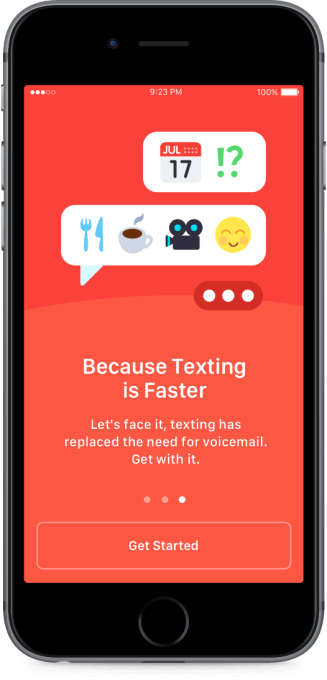
No More Voicemail offers a different solution. The app isn’t actually disabling voicemail per the carrier – it only seems like it is. Instead, No More Voicemail uses the conditional call forwarding feature on your phone to send your unanswered calls to a virtual number that will just ring and ring.
This is the same concept that’s used today in other legit third-party voicemail apps like YouMail or Google Voice, expect it ditches the idea of offering a hosted voicemail system.
Calls won’t be shuffled off to No More Voicemail’s third-party system until you reject or ignore the call. That means you’re able to pick up calls normally when you have time to talk.
But if you choose to not take a call, the callers will just hear the phone ring forever, the company claims.
Eventually, callers should get tired of waiting for voicemail to pick up and will hang up. (Then hopefully text you instead!)
The process of setting up No More Voicemail is straightforward. You’re provided an activation code to copy and paste into your phone’s dialer, which you then call to make the necessary changes.
 
In practice, I found that this process failed the first time I tried it, then succeeded on the second go-round. When testing this further, I declined an incoming call, but found that the phone didn’t ring indefinitely as promised, but rather rang a bit then automatically disconnected the call.
Sadly, that’s far from perfect. But even if it’s a little buggy, it did prevent my voicemail from picking up and taking the call on my behalf. And I’m hopeful these kinks will get worked out over time.
(I’m using an iPhone 6s running a beta build of iOS on T-Mobile, so it’s possible that I’m not the best test subject, I should point out. Your mileage may vary!)
Disabling No More Voicemail uses a similar process as activating the service. This worked as advertised in tests.
The app is the latest creation from TelTech Systems, a company that has released a number of telecommunications apps over the years. It’s probably best known for TrapCall, a service released in 2009 that unmasked Caller ID on blocked incoming calls, or its earlier SpoofCard Caller ID spoofing service.
“We think voicemail is a thing of the past and that it just makes life a little easier to never have to worry about checking and returning voicemails,” explains TelTech partner on Special Projects, Nate Kapitanski. “If it’s important, people will text you or message you on one of the various messaging apps,” he says.
No More Voicemail is supported on all the major carriers at launch, including AT&T, Verizon, T-Mobile, Sprint and US Cellular. The app is a free download on the iTunes App Store and Google Play. 

Comments

Popular posts from this blog

The EHang 184 Is A Human-Sized Drone Taking Off At CES

We’ve seen some pretty cool stuff on day 1 of CES 2016, but probably nothing more eye-catching than the EHang 184, a human-sized drone built by the Chinese UAV company  EHang . Yes you heard right — a giant autonomous drone that fits a human. It’s basically what you would expect to see if someone shrunk you down to the size of a LEGO and stuck you next to a DJI Inspire. Except no one was shrunk, and the giant flying machine was sitting smack in the middle of the CES drone section. EHang, which was founded in 2014 and has raised about $50M in venture fundingto date, was pretty gung-ho about telling everyone at CES that the 184 was the future of personal transport. And for the most part, people were too in awe to question them. But the reality is that the company probably was using the 184 as more of a marketing tool for their standard-sized drones like the  Ghost . Not that we’re saying that the 184 will never be a real thing, just that it probably isn’t co...

Western Union Brings Money Transfer And Its Tricky Fees To Chat Apps

Remittance has always been a shady business. Migrant workers need to send money they earn home to their families, but get hit with fine print fees so less cash comes out the other side than they might assume. Remittance companies earn extra by keeping the margin between their own made up exchange rate and the real one. Western Union is the best known remittance company, with 500,000 brick-and-mortar locations around the world. But tech startups like TransferWise, Azimo, and WorldRemit are gunning for the business. They hope to increase convenience and reduce fees to lure customers away from Western Union, Moneygram, and other old-school remittance providers. So  Western Union  is going digital thanks to partnerships with big messaging apps. It launched its Western Union Connect system in October last year, followed by a partnership with WeChat for sending up to $100. Now it’s getting into bed with  Viber , which has over 664 million “unique” users, thou...

Google Calls Out EFF Over Bogus Claims That It Snoops On Students With Its Chromebooks

The Electronic Frontier Foundation (EFF) caused quite a stir this week when it alleged that Google is using its Chromebook platform, which has made a significant impact in the education sector, to snoop on students. The charges were damning, with the EFF claiming that Google was violating its own corporate policies and using students’ personally identifiable browsing data/habits to refine its services, in addition to sharing that data with partners. "EFF bases this petition on evidence that Google is engaged in collecting, maintaining, using, and sharing student personal information in violation of the 'K-12 School Service Provider Pledge to Safeguard Student Privacy' (Student Privacy Pledge), of which it is a signatory,” alleged the EFF in its initial FTC complaint. Google takes such allegations very seriously, and has thus responded to every claim brought forth by the EFF. “While we appreciate the EFF’s focus on student data privacy, we are confid...

Following Patent Deal, Every Time Apple Sells An iPhone, Ericsson Gets A Bit Of Money

Telecommunications infrastructure company Ericsson just  announced  that it has reached an agreement with Apple over an ongoing patent dispute. For the next seven years, Apple will pay a fraction of its iPhone and iPad profit to Ericsson in royalties. Back in February, Ericsson filed suits in many different jurisdictions for patent infringement (the International Trade Commission, the U.S. District Court for the Eastern District of Texas, the U.S. District Court for the Northern District of California, as well as courts in the U.K., Germany and the Netherlands). According to the Swedish company, Apple has been violating 41 patents over the past few years with its iPhone and iPad, in particular patents related to GSM, UMTS and LTE technologies. As expected, the two companies have reached an agreement and Ericsson is dropping all of its lawsuits. Today’s news isn’t particularly surprising as Ericsson holds more than 35,000 patents. Many of them are related to wireles...

NVBOTS Wants To Make 3D Printers As Easy As Toasters

Right now 3D printing curriculums, if they exist, are fairly sparse. Putting a two thousand dollar machine in front of a grade schooler usually ends up in a lot of 3D printed Yoda heads and not much education while the learning curve for most 3D design tools is steep. That’s what the founders of NVBOTS, AJ Perez, Forrest Pieper, Christopher Haid, and Mateo Peña Doll, are looking to solve. Their product, the  NVPRO , is a 3D printer with a few interesting features. The two most interesting are the automatic removal system which pops parts off of the build plate when they are done and a built-in print server that allows you to print from any device. This means you can run large batches of prints from different users with each part popping off as its printed. This means a class of students can send jobs to a printer and then pick them up just as they would a laser printer. The printer also supports a central “admin” who can check jobs before they are printed as and offers a ...