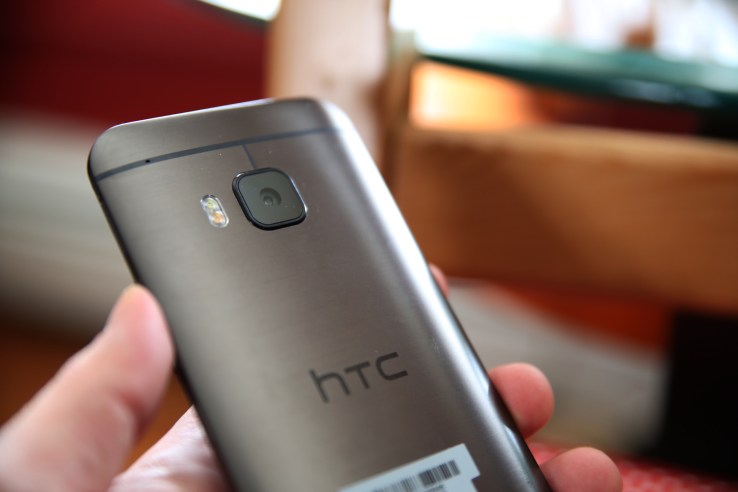
HTC Hints It’s Looking At Mobile VR


Despite not unboxing a new high end smartphone at Mobile World Congress this week, embattled mobile maker HTC has told TechCrunch it’s not ready to admit premium defeat — saying it has a new flagship device coming soon.
It’s also hinted it might consider getting into mobile VR in future — presumably as a step to try to revive interest in its premium smartphones. Earlier this month the company posted a $101 million net loss for Q4 2015, with CFO Chialin Chang admitting sales of its flagship HTC One M9 “fell short of expectation” last year.
Meanwhile, this time last year the company took the wraps off of a high end VR headset — called Vive — plus partnership with games publisher Valve to build a virtual reality ‘experiences’ ecosystem. So it has at least been riding high on recent plentiful VR hype.
A year on from the Vive unveiling, the pair announced pricing for their ‘room-scale’ VR experience at MWC16. The headset, which will go on sale in April, costs $800(plus the price of a powerful enough PC to drive it).
So, as with rival device the Oculus Rift, it’s not being priced for mainstream adoption — leaving plenty of room for a more budget VR experience, a la Samsung’s smartphone-powered Gear VR, should HTC decide it can afford to spread itself a little more thinly.
Asked directly about the possibility of the company making a phone-powered VR headset, Drew Bamford, corporate VP of HTC’s Creative Labs, told TechCrunch: “I can’t comment on our future roadmap but you can imagine HTC is as design led and innovation led business and of course it would make sense for us to work on more kinds of VR products, and products that unite our phone business and our VR business in ways that make sense.”
Company chairperson Cher Wang was quoted in The Telegraph last month saying VR is now the main priority for the company, telling the paper: “Yes, smartphones are important, but to create a natural extension to other connected devices like wearables and virtual reality is more important.”
Despite Wang apparently de-emphasizing smatphones by prioritizing VR, Bamford said HTC remains committed to the phone space — and not just to making mid-range devices either (at MWC this week it released a clutch of mid-range handsets, leaving new premium offerings from Samsung and LG to go unchallenged).
So have we seen the last flagship device from HTC? “No, absolutely not,” said Bamford. “And in fact you should expect an announcement about our next flagship very soon.”
“We are absolutely committed to making the world’s most desirable, best phone products in both the premium segment, with the One series, the M Series, and in the mid range with the Desire products,” he added.
“And we’re continuing — one of the reasons I’m here this week is we’re talking to our operator partners about our next generation phone products, and there’s all sorts of exciting work going on there. We will have some really cool stuff on the market.”
Last month HTC also denied rumors it is looking to spin out its VR business into a standalone company. Such a move might be premature — given that mass market VR adoption is more likely to come from a $100-priced device like Samsung’s Gear VR than a $800+ high end system. So having both a high end VR play and a smartphone business under one roof might position HTC to plug into both (nascent) markets.
“We have multiple priorities. This is a common theme at HTC,” added Bamford. “There’s always more than one priority. Certainly the phone business is also a priority. And still far and away our biggest business and in fact we’ve only just started selling the wearables in January. And we have not started the VR product so actually phones is our main business absolutely.”
Bamford went on to describe the “problem” of designing how different connected products work together as both “really exciting” and “an opportunity”.
“These days in interaction design some of the most interesting opportunities are how do you make disparate products function as a system,” he said. “We’ve tackled that at a smaller scale with our wearables – with the Healthbox which is a kit of three products that are integrated into a system, united by a software and service back end.
“And there’s an opportunity to do that at a higher level with phones, wearables and VR. Think about how do those product categories work together.”

Comments

Popular posts from this blog

What is your preferred smartphone screen size

Screen envy. We all have it. Or do we? See, that’s the thing, I’m just not so sure. One thing I am sure about is that our phone screens have gotten progressively bigger and bigger over the last few years. The funny thing is, we as a society have taken that ball and run with it, like we just don’t care. But I always thought we did care? Some time ago, when phones were in the sub-5” range, we used to have a term called “phablet” which described an almost absurdly big phone. The definition varied from person to person. I always considered a phone with a screen 5.5” or bigger to be a phablet. The Galaxy Note fell into that category. The Lumia 1520 certainly did. There are others as well. I was safely ensconced in the 4.5” area at the time with my Lumia 920. What did I know? Leon’s getting laaaaaaaarrrger But slowly, phones started topping the 5” mark. I’m not talking about phablets here, I’m talking about normal flagship phones – the Galaxy S4 (barely) and the HTC One (M7) are ...

Best Web Design Company in Pondicherry

#Technology    has two faces. We all feel it, but sometimes can’t find words to describe it.  #Ebooks    are the best example to show the 0-1 nature of emotions the  #technology  evokes. #itwhere    provide a  #Best     #solutions    to  #Growyourbusiness    feel free to drop a  #Mail    info@itwheretech.co.in www.itwheretech.co.in 

eGym raises $45M Series C for cloud-connected gym equipment and fitness software

eGym , the Munich-based startup that offers cloud-connected gym equipment and supporting cloud software and app for the fitness training floor, has closed $45 million in Series C funding. The round was led by new investor HPE Growth Capital, while existing investors, including Highland Europe, also participated. The problem that eGym is looking to solve is that, whilst gyms have moved from a bodybuilder market to a mass market in the last 20 years, the technology in gyms lags behind. That’s despite the fact that better use of technology can help to reduce customer churn, the biggest pain-point of both gym operator and gym users. Comprising of an app for both gym user and trainer, combined with the company’s connected strength machines, the eGym Cloud makes it possible for gym members to receive better fitness instruction and an evolving and personalised fitness plan based on data collected as they workout. And by providing a better workout feedback loop, gym goers can get an i...

Facebook Now Supports PGP To Send You Encrypted Emails

You can now instruct Facebook to encrypt every email it sends to you so nobody — not even the NSA — is likely to be able to read your messages anytime soon. All you have to do is import your public PGP key into your Facebook settings and you’re good to go. The problem here, of course, is that most people have no idea how public/private key email encryption works and how to even get started with it. In the wake of Edward Snowden’s leaks, a number of organizations, including Google, promised to completely hide the complexities of end-to-end email encryption from regular users. Very few of these products have materialized so far, however — not for lack of trying, but because this is actually a very complex problem, both from a technical and user experience perspective. Facebook uses the well-established PGP scheme (the GNU Privacy Guard implementation of  OpenPGP, to be precise) to encrypt messages and tools lik...

LeafLink Raises $750K To Become Salesforce For The Cannabis Industry

LeafLink , an NY-based wholesale management platform for the cannabis industry, has closed a $750k seed round led by group of NY angel investors. The software platform is designed to support participants in a B2B supply chain, providing basic tools designed to save money for retailers and allow producers to get better pricing for their product. These tools will include a centralized location to view correspondence between buyers and suppliers, inventory and order tracking tools, and a portal to discover new products and services so users can source leads and close deals from within the platform. Founders Ryan Smith and Zach Silverman explained that they “believe cannabis regulation and distribution is moving toward mimicking the alcohol industry with regional distributors and nonsensical supply chain participants”. By focusing on creating a supply chain similar to the alcohol industry, the company hopes to eventually be the universally accepted way for buyer...