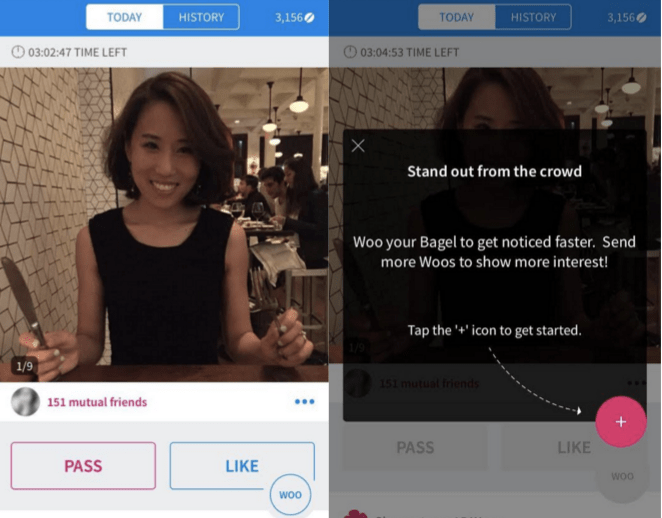
Coffee Meets Bagel Adds Its Own Version Of Super Like With ‘Send A Woo’


In the past few months, Tinder has been working on a feature called Super Like, which let users tell one of their matches that the situation is more serious than simply swiping right. Today, Coffee Meets Bagel has added something similar in ‘Send A Woo’, letting CMB users express higher-than-usual interest in a potential match.
Coffee Meets Bagel launched in 2013 with an interesting twist on online dating. Rather than swiping through endless matches as though you’re playing a mobile version of ‘Hot or Not,’ Coffee Meets Bagel promised its users one potential match a day. Using Facebook Connect, the app could sift through friends of friends to make sure these matches were somewhat relevant.
If both users liked each other, the app would then connect them in a text conversation. Since then, the app has grown up a lot, ditching Twilio as a way to start text conversations and opting for in-app Instant Messaging. Oh, and Coffee Meets Bagel also raised $7.8 million in funding in February of 2015.
Founder and CEO Dawoon Kang says that January is one of the hottest times for online dating, and that the introduction of ‘Send a Woo’ is meant to help users find more meaningful connections and have more meaningful conversations with those connections.
Coffee Meets Bagel facilitates this connection through the “Bean Shop”, which essentially lets you spend real money to have virtual currency to spend within the app. Users must use beans to send woos, among other things like check out mutual friends.
Because Coffee Meets Bagel only allows one match per day, the ‘Send A Woo’ feature will likely grow in popularity, as you only have 24 hours to get someone to like you back and you have no other potential dating options on that site for the whole day.
In beta testing, Kang said that the app saw 3x more matches for folks who used ‘Send a Woo’.

Comments

Popular posts from this blog

Workato Chat Bot Brings Enterprise Workflow Into Slack

As we head into 2016, enterprise chat applications like  Slack  are suddenly a hot commodity, and if you’re inside chat a good portion of the day the argument goes, you should be able to access other work without leaving the chat client. This is exactly what  Workato’s  newly announced chat bot, Workbot, is designed to do. Chat bots are small programs that integrate with a chat platform and provide some advanced type of functionality in a fairly easy fashion. The new Workbot-chat bot enables users to access and control over 100 enterprise applications such as a Salesforce CRM record, Quickbooks accounting information or Zendesk customer service interactions directly inside of Slack. One of the primary issues with early Enterprise 2.0 tools was that they were just another application busy employees needed to pay attention to. The idea here is to give users customer information directly in the context of the discussion they may be having...

Best Web Design Company in Pondicherry

#Technology    has two faces. We all feel it, but sometimes can’t find words to describe it.  #Ebooks    are the best example to show the 0-1 nature of emotions the  #technology  evokes. #itwhere    provide a  #Best     #solutions    to  #Growyourbusiness    feel free to drop a  #Mail    info@itwheretech.co.in www.itwheretech.co.in 

Montana-based mapping startup onXmaps raises a round of funding fit for Big Sky Country

A mapping startup based in Missoula, Mont., which allows users to download sophisticated offline topographic maps outlining public and private lands and a number of other features geared towards hunting, fishing and camping, has pulled in its first major outside funding. onXmaps has closed a $20.3 million Series A round led by Summit Partners. Bessemer Venture Partners, Millennium Technology Value Partners, Next Frontier Capital and NBCUniversal CEO Steve Burke also participated in the round. The company is calling the fundraise one of the biggest ever among startups based in Montana. onX Hunt app This is impressively the first bout of outside funding that the 70-person startup has ever taken since being founded in 2009. The company’s founder and CEO Eric Siegfried, an avid outdoorsman himself, had created a more basic program to integrate these maps with his own Garmin GPS. After finding his friends were interested in having a product like this too, he put down $27k of his...

Phoenix OS is (another) Android-as-a-desktop

Google Android may have been developed as a smartphone operating system (and later ported to tablets, TVs, watches, and other platforms), but over the past few years we’ve seen a number of attempts to turn it into a desktop operating system. One of the most successful has been  Remix OS , which gives Android a taskbar, start menu, and an excellent window management system. The Remix OS team has also generated a lot of buzz over the past year, and this week the operating system gained a lot of new alpha testers thanks to a  downloadable version of Remix OS  that you can run on many recent desktop or notebook computers. But Remix OS isn’t the only game in town.  Phoenix OS  is another Android-as-desktop operating system, and while it’s still pretty rough around the edges, there are a few features that could make it a better option for some testers. Some background I first discovered Phoenix OS from  a post in the Remix OS Google Group , altho...

Engineering against all odds, or how NYC’s subway will get wireless in the tunnels

Never ask a wireless engineer working on the NYC subway system “What can go wrong?” Flooding, ice, brake dust, and power outages relentlessly attack the network components. Rats — many, many rats — can eat power and fiber optic cables and bring down the whole system. Humans are no different, as their curiosity or malice strikes a blow against wireless hardware (literally and metaphorically). Serverless software deployment to the cloud, this is not. New York City officially got wireless service in every underground subway station a little more than a year ago, and I was curious what work went into the buildout of this system as well as how it will expand in the future. That curiosity is part of a series of articles I’ve written on an observed pattern known as cost disease, the massively inflating costs of basic human services like health care, housing, infrastructure, and education. The United States spends trillions of dollars on each of these fields, massively outspending sim...