
CellSavers, An On-Demand Smartphone Repair Startup, Raises $3M


CellSavers co-founder Itai Hirsch was not a fan of driving to a local repair shop after he’d broken many of his phones and tablets.
So he decided to take a run at building CellSavers, an on-demand repair service that’s like an Uber for smartphone repairs. To do that, CellSavers has raised $3 million in seed funding from Sequoia Israel. CellSavers connects users with technicians that will come to them and repair a broken battery or a cracked screen. A cracked iPhone 6 screen repair, for example, costs $99.
“We look at how Uber changed the way from hailing a taxi in the rain to pressing a few buttons from your mobile device, that’s how we look at the process,” Hirsch said. “It’s very limited interaction between the end-user and the technician. When you’re distressed and you break your phone it’s a low point in your day, and we try to create this positive experience. We see this as a lifeline, we want to make sure you aren’t without your device for more than 30 minutes.”
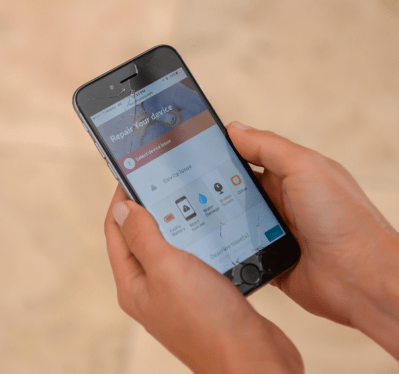
cellsavers broken screenThe goal is to bring a technician to the user within 30 minutes (the average response time in New York City for the company) in order to repair their device — though, that’s easier said than done. The company has a real-time match-making algorithm that connects technicians with the right skill sets to users that need repairs.
One of the hooks for CellSavers? It builds up trust with its technicians before tasking them with some of the most difficult repairs. The service has three levels of technicians, and as those technicians do more repairs and the reviews come in, they basically get access to more jobs, Hirsch said. That vetting process is designed to not only ensure quality in repairs, but trust in those technicians, and technicians average about $25 to $30 an hour, he said.
“A lot of our technicians are actually Apple employees or started there, they join our platform,” he said. “They gradually increase their demand with time, we do end-to-end reviews, a lot when they start working with us try to make it into a full-time position just because our earnings with us are far more than the average paid retail store.”
There are a lot of analogies to other phone repair services, like iCracked, however — which will likely prove to be stiff competition for CellSavers. The company is not an agency, Hirsch says, and the user only interacts with the company through the app. CellSavers’s primary competition, he said, are local repair shops that are frequently visited — and the goal of the company is to ensure that users don’t have to drop off their devices and be without them for a long period of time, he said.

From day one, Hirsch said he focused on making sure the unit economics for on-demand repair worked in the company’s favor. The company didn’t subsidize its service right away, and hopes to ensure that as it scales it continues to be a healthy business. That’s not going to be easy, as on-demand in general is a tough place to work in, but Hirsch said that the company’s business model is one of the things that attracted Sequoia in the first place.Hirsch also wants technicians to be able to travel to wherever the user is, and often that ends up being a gym, he said. It’s not all that surprising — it’s a somewhat precarious place where you could easily break a phone — but those destinations should also be homes, coffee shops, or even for travelers who just accidentally smashed their phones.

Comments

Popular posts from this blog

Facebook Now Supports PGP To Send You Encrypted Emails

You can now instruct Facebook to encrypt every email it sends to you so nobody — not even the NSA — is likely to be able to read your messages anytime soon. All you have to do is import your public PGP key into your Facebook settings and you’re good to go. The problem here, of course, is that most people have no idea how public/private key email encryption works and how to even get started with it. In the wake of Edward Snowden’s leaks, a number of organizations, including Google, promised to completely hide the complexities of end-to-end email encryption from regular users. Very few of these products have materialized so far, however — not for lack of trying, but because this is actually a very complex problem, both from a technical and user experience perspective. Facebook uses the well-established PGP scheme (the GNU Privacy Guard implementation of  OpenPGP, to be precise) to encrypt messages and tools lik...

Laser gun is deployed and operational on U.S. Navy warship

After several years of research and testing, the U.S. Navy has introduced a new laser gun designed to protect ships without using ammunition.   Another entry on our  timeline  is now a reality as the U.S. Navy has authorised the first operational use of a laser weapon. This new hi-tech system – known as the Laser Weapon System (LaWS) – is designed to serve as a form of defence against drones and other small flying vehicles or small-boat enemies including suicide attackers. It is highly accurate, able to hit objects moving at up to 300 mph (480 km/h). The LaWS fires a solid-state infrared beam with two modes: high output to destroy a target, and low output for optical "dazzling", warning shots or to cripple a potential attacker. Among the advantages of this device versus projectile weapons is the low cost per shot, as each firing of the weapon requires only minimal cost for generating the energetic pulse; by contrast ordnance for projectile weapons must be des...

Intel announces the first 14 nanometre processor

At the Computex conference in Taipei, chipmaker Intel has revealed a fanless mobile PC reference design using the first of its next-generation 14nm "Broadwell" processors. The 2 in 1 pictured here is a 12.5" screen that is just 7.2 mm thick with keyboard detached and weighs 670 grams.  The Surface Pro 3  – for comparison – is 9.1 mm thick and weighs 800 grams. It includes a media dock that provides additional cooling for a burst of performance. The next-generation chip is purpose-built for 2 in 1s and will hit the market later in  2014 . Called the Intel Core M, it will be the most energy-efficient Intel Core processor in the company's history with power usage cut by up to 45 percent, resulting in 60 percent less heat. The majority of designs based on this new chip are expected to be fanless, with up to  32 hours of battery life,  offering both a lightning-fast tablet and razor-thin laptop. Intel is also delivering innovation and performance for the ...

How to Choose BitLocker Drive Encryption Method and Cipher Strength in Windows 10?

BitLocker is an encryption method that enables users to lock the different drives in  Windows . The drives which are protected by BitLocker are accessed by passwords. Windows has provided opportunity for users to choose and configure the  cipher  strength and algorithm used by BitLocker Drive Encryption. This can be achieved via the Local Group Policy editor. The Local Policy Editor will let you configure and select the cipher method for BitLocker encryption. By default it is not configured but you can choose your choiceable encryption method by enabling the Policy Setting. If the drive is already encrypted or if encryption is in progress, the encyption method will have no effect. If you leave the policy unconfigured, then BitLocker will use the default encryption method of AES 128-bit with Diffuser or the encryption method specified by the setup script. Steps to Choose BitLocker Drive Encryption Method and Cipher Strength in Windows 10 1.  ...

Metaio’s Thermal Touch Gets A Little Bit Smaller At MWC 2015

We first reported on  Metaio’s Thermal Touch concept  for Augmented Reality interaction last spring. Still in its infancy, the concept relies on thermal imaging cameras to track residual heat your body leaves on surfaces that it touches. Metaio’s software can track these heat signatures so they act as “clicks” or “touches” in Augmented Reality interfaces that only the user sees on interactive eyewear or devices. It’s a pretty interesting concept and will undoubtedly open a new realm for User Experience and User Interface experts to ponder. The first prototype we looked at was crude and completely impractical—an iPad with a giant thermal camera attached to it. Indeed, a few people pointed out to me “why would you need to touch external surfaces, when the iPad screen is right in front of you?” However that question totally misses the point of the prototype, which was really just proving the concept was worth further exploration. This next concept for thermal touc...