Apple Releases First Battery Case To Eat Third-Party Accessory Makers’ Lunch


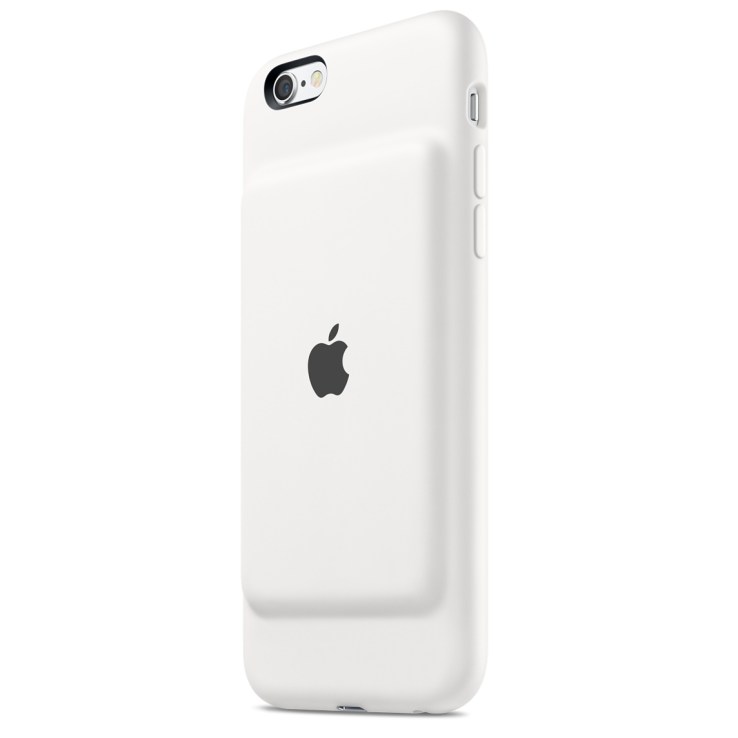
In a surprise move, Apple just announced an external battery case for the iPhone 6s. Named the iPhone 6s Smart Battery Case, the battery extends the battery life of your iPhone 6s by up to 25 hours. The new accessory is available in black and white for $99 starting today.
Let’s start with the design. Apple is using silicone as the main material like on its other cases. The company doesn’t disclose the capacity of the battery except that you’re supposed to get 18 to 25 hours of extra battery.
Like third-party battery cases, Apple uses a Lightning male port at the bottom to plug your iPhone. You can charge the case using a traditional Lightning cable — most third-party batteries rely on a microUSB cable. Apple’s accessory also works with the iPhone 6 and it looks like there isn’t a 6 Plus and 6s Plus version.
The Smart Battery Case features an unfortunate hump at the back. Mophie’s Juice Pack design is a bit sleeker compared to Apple’s official accessory. Apple made sure that you can access all the buttons, cameras and microphones when you use the case.
So why is Apple releasing this accessory when third-party accessory makers are doing a fine job? It’s all about getting more money out of iPhone owners. By releasing an official accessory, Apple can capture all of the profits with the Smart Battery instead of selling Mophie and Anker batteries in its Apple stores.
That’s also the reason why Apple released the Smart Cover and Smart Case for the iPad. Most iPad owners have been buying these cases in addition to their iPads, and Apple has some nice margins on these accessories.
Apple has made many recent efforts when it comes to accessories. The Apple Pencil is a nifty addition to the iPad lineup and a great way to promote the iPad Pro. The company also released a new keyboard, touchpad and mouse, an Apple Watch Dock and an iPad Pro keyboard. In the end, it’s all about eating third-party accessory makers’ lunch. But some of them are truly great accessories, and you’re not forced to buy them — so it’s hard to complain.

Comments

Popular posts from this blog

SoftBank Lands $236M From Alibaba And Foxconn To Bring Its Pepper Robot To The World

Remember Pepper,  the intelligent robot that SoftBank unveiled last year ? Pepper goes on sale in Japan this coming weekend, but in advance of that launch  SoftBank has revealed  that Alibaba and manufacturer Foxconn have invested $118 million each in its robotics division. That deal will give Alibaba and Foxconn 20 percent shares in SoftBank Robotics Holdings (known as SBRH), with SoftBank retaining a dominant 60 percent stake. “SoftBank, Alibaba and Foxconn will build a structure to bring Pepper and other robotics businesses to global markets, and cooperate with the aim of spreading and developing the robotics industry on a worldwide scale,” SoftBank said in its announcement. SoftBank isn’t short on money, of course — it is building up quite a portfolio of e-commerce investments across Asia — but its two partners bring know-how, strategy and global networks to the table. So, it looks like Pepper has eventual world domination plans. Or, at least, ...

How ad-free subscriptions could solve Facebook

At the core of Facebook’s “well-being” problem is that its business is directly coupled with total time spent on its apps. The more hours you pass on the social network, the more ads you see and click, the more money it earns. That puts its plan to make using Facebook healthier at odds with its finances, restricting how far it’s willing to go to protect us from the harms of over use. The advertising-supported model comes with some big benefits, though. Facebook CEO Mark Zuckerberg has repeatedly said that “We will always keep Facebook a free service for everyone.” Ads lets Facebook remain free for those who don’t want to pay, and more importantly, for those around the world who couldn’t afford to. Ads pay for Facebook to keep the lights on, research and develop new technologies, and profit handsomely in a way that attracts top talent and further investment. More affluent users with more buying power in markets like the US, UK, and Canada command higher ad prices, effectively...

Facebook will verify the location of U.S. election ad buyers by mailing them postcards

Facebook’s global director of policy programs says it will start sending postcards by snail mail to verify buyers of ads related to United States elections. Katie Harbath, who described the plan at a conference held by the National Association of Secretaries of State this weekend, didn’t reveal when the program will start, but told Reuters that it would be before the Congressional midterm elections in November. The cards will be sent to people who want to purchase ads that mention candidates running for federal offices, but not issue-based political ads, Harbath said, and contain a code that buyers need to enter to verify that they are in the U.S. The program is similar to ones used by Google My Business and Nextdoor when they need to verify business owners or users who want to join closed neighborhood groups, respectively. Harbath told Reuters that the postcards “won’t solve everything,” but were the most effective method the company came up with to prevent people from using fa...