Apple Pushes Users To Upgrade Their iPhones Via Pop-Up Ads In The App Store


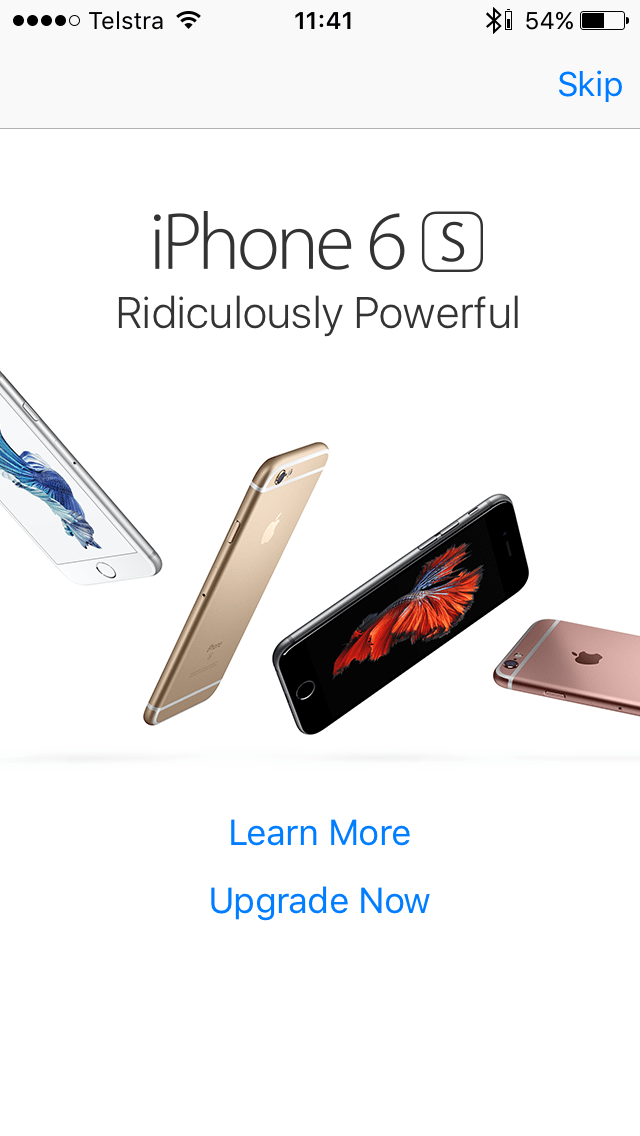
Likely in hopes of boosting its holiday sales, Apple has surprised a number of iPhone owners by displaying unsolicited pop-up ads within the App Store application that promote the iPhone 6s. The ads are full-screen interstitials, and appear on iPhones that are older than the iPhone 6, according to reports. The ad’s text, meanwhile, reads “iPhone 6s Ridiculously Powerful.”
Below an image of several, multi-colored iPhones, users are offered two choices: “Learn More” or “Upgrade Now.”
In order to bypass the ad, users have to hit the “Skip” button at the top to return to the App Store.
The reaction to the ads, first spotted by the blog Cult of Mac, has not been pleasant so far. Most users who are sharing the ads on social media, or discussing the problem on Reddit, don’t seem to think that Apple should be leveraging its own App Store application to deliver ads – especially those that are promoting its own products.
There’s some irony here as well, given that Apple introduced ad blocking capabilities with the release of the iOS 9 operating system, which allows web users the ability to better control how much advertising they’re exposed to when using their mobile devices, plus block other content that slows down browsing. The move was heralded as another example of how Apple puts the   user experience first.
Pushing pop-up ads, however, seems to contradict that earlier position.
It’s worth pointing out this is not the first time Apple has used the App Store app in this way. In the past, Apple experimented with using the App Store’s search interface to push its own, editorialized search results for specific queries. For example, a search for “Maps” for a time wouldn’t return Google Maps first, but instead pointed to Apple’s own collection of mapping apps. And a search for “Music,” also around the same time last year, didn’t immediately return a list of streaming apps, but instead showed an ad for iTunes radio.
In other words, Apple has already proven that it’s not above leveraging the App Store app’s reach in order to promote its products when it deems necessary. And for it to be again trying the same thing with regard to the iPhone hints that the previous efforts must have seen positive results.
That being said, the new ad is a bit more aggressive than the others. While you could argue that, before, users who were searching for things like “maps” or “music” were possibly interested in what Apple had to offer on those fronts, the newer ads are being pushed to those who have simple launched the App Store app. They may or may not actually be in the market for a new device.
It’s unclear at this time how many users are being shown these ads, or if they’re only appearing in certain regions or markets. If Apple offers more information about the ads, we’ll update.

Comments

Popular posts from this blog

Five budget-friendly open source storage servers

Storage is essential for the enterprise: Data must be stored. Data must be retrieved. Data must be shared. Data must be secured. At the same time, storage must not consume the entirety of your IT budget. Fortunately, you can find effective solutions in the world of open source. Outside of cost effectiveness, one of the biggest benefits of these solutions is the ability to modify them to perfectly fit your needs. You can make minor changes or even roll your own storage solution based on one of these tools. If you want enterprise support and a "solution in a can" that will meet just about any enterprise storage need, you should turn to Red Hat or SUSE. Both Linux-based companies offer some of the most powerful enterprise-ready tools on the market. But if you'd rather get your hands dirty and craft something of your own—something that won't demolish your budget—these five open source tools are a great place to start. 1: ownCloud ownCloud ( Figure ...

Google Announces “Purchases On Google” For Buying Straight From PLAs And Other Mobile Shopping Updates

The much-anticipated buy button in Google search ads is finally here. Called Purchases On Google, it turns out the new feature isn’t a button at all. “Buy on Google” messaging will appear in eligible product listing ads on both iOS and Android smartphones. Purchases on Google is launching in a very limited pilot with select retailers. When consumers click on Purchases On Google-enabled ads, they’ll be taken to a page hosted by Google where they can make a purchase using payment criteria stored with Google. The orders are then passed through to the retailer for fulfillment and any customer service follow up. Check out our full coverage  where you’ll find many more details about Purchases On Google on our sister site Marketing Land. Google also announced several of other updates to mobile PLAs: New Mobile Shopping Ad Formats For Voice Search When consumers use voice search to find products, Google is starting to show...

Visa confirms Coinbase wasn’t at fault for overcharging users

Yesterday, we wrote that Coinbase customers were being charged multiple times for past transactions. While some speculated that the erroneous withdraws were down to a Coinbase engineering issue, Coinbase issued a statement saying it wasn’t liable for the duplicate charges. The blame, instead, rested with Visa for the way it handled a migration of merchant categories for cryptocurrencies, Coinbase said. While you can read my post yesterday for an in-depth description of what happened, the basic gist is that Visa refunded and recharged (under a different merchant category) a month of old transactions. Many users saw the recharge come through before the refund processed, making it look like they were double charged. Honestly, the issue was likely exacerbated by existing payment rails — it’s normal for refunds to take multiple days to show up on credit and debit statements. But here’s where it gets weird — this morning Visa issued a statement to some publications shifting the blam...

Facebook will verify the location of U.S. election ad buyers by mailing them postcards

Facebook’s global director of policy programs says it will start sending postcards by snail mail to verify buyers of ads related to United States elections. Katie Harbath, who described the plan at a conference held by the National Association of Secretaries of State this weekend, didn’t reveal when the program will start, but told Reuters that it would be before the Congressional midterm elections in November. The cards will be sent to people who want to purchase ads that mention candidates running for federal offices, but not issue-based political ads, Harbath said, and contain a code that buyers need to enter to verify that they are in the U.S. The program is similar to ones used by Google My Business and Nextdoor when they need to verify business owners or users who want to join closed neighborhood groups, respectively. Harbath told Reuters that the postcards “won’t solve everything,” but were the most effective method the company came up with to prevent people from using fa...