How Elio Motors Is Crowdfunding A Three-Wheel, 84 MPG Vehicle


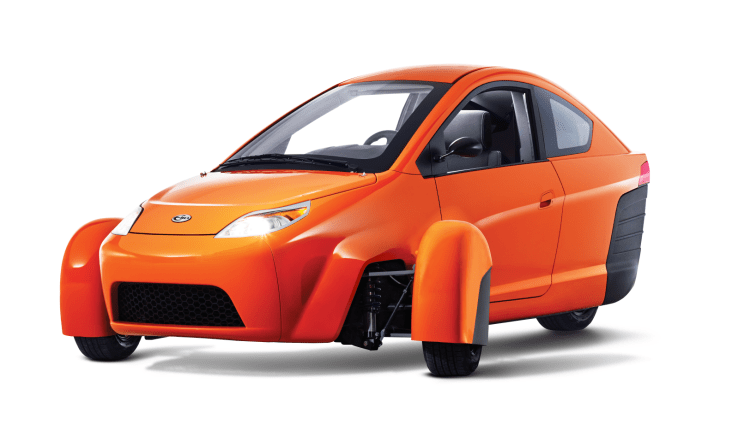
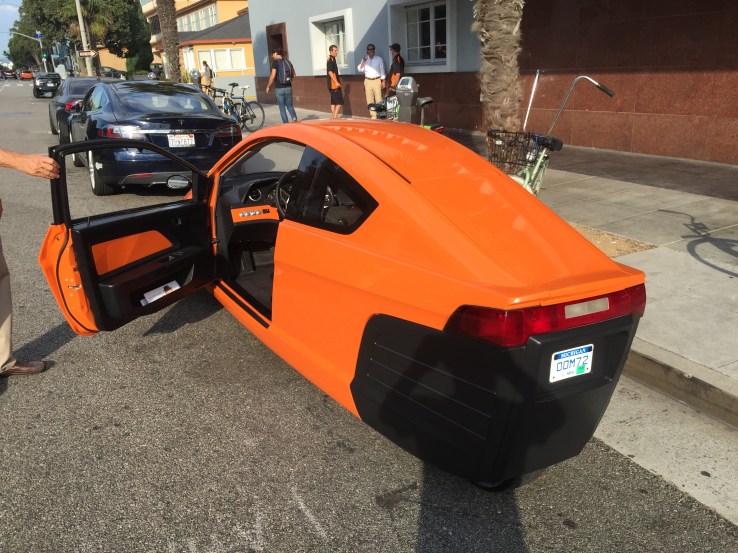
Recently I had the chance to test drive the latest prototype version of Elio, a three wheel, two-seater built by Elio Motors. The vehicle, which is about half the width of a regular car and looks straight out of Silicon Valley, aims to eventually retail for a base price of around $6,800.
Elio Motors was founded in 2008, and is in the midst of fundraising to start manufacturing vehicles in a recently purchased old GM factory in Louisiana. The car, which is technically classified as a motorcycle because of its three wheels, has already received about 45,000 preorders.
Like most heavy manufacturing startups, the company is waiting on funding to enter production. Paul Elio, founder and CEO of Elio Motors, said the company needs about $300 million before they can start producing cars, and so far hasn’t had luck with the traditional routes of raising venture capital. “Private equity won’t do pre-revenue investments, and VCs think the project is too big for an eventual follow up check,” explained Elio.
However, the company is exploring a few non-traditional funding options, one of which will take advantage of Regulation A+, a new SEC regulation that will finally allow non-accredited investors to invest in private startups.
0E9A929B-8BC7-4CF4-9879-B23DB44DEB15
A provision of the JOBS act (but only finalized in June), Regulation A+ essentially lets companies crowd fund up to $50M in funding from anyone, in return for a stake in the company.
Here’s how regulation A+ works: Companies first enter a “Test The Waters” period where they can advertise that they are accepting investments, and investors can pledge a non-binding amount. After gaining significant interest, companies need to submit a Form 1-A offering statement to the SEC, as well as complete a full financial audit.
After approval, the company can then collect money from investors, who eventually get common stock and a spot in the corporation’s cap table. Having public investors on the cap table also means that the company is required to regularly file public annual and semi-annual reports with the SEC.
Regulation A+ launched on June 19th, the same day Elio Motors began their “Test The Waters” period. The company contracted StartEngine to run the campaign, which is a new crowdfunding platform specifically built to guide companies through the Regulation A+ fundraising process. So far, over 100,000 investors investors have pledged $37M for Elio Motors.
Since the program is so new, no companies have actually been approved by the SEC to move past the pledge period and actually start collecting money from investors. This means there is no precedent or statistics on how many investors will actually follow through after their initial pledge.
However, both StartEngine and Elio Motors expect that the vast majority of these pledges will actually convert to investments. Ron Miller, cofounder of StartEngine, explained that since the current pledged amount is around $37 million but Elio only applied to raise $25 million, he expects demand to actually go up once investors realize not all that pledged will be able to actually invest.

elio11_interior2
For the rest of the money needed, Elio has applied for an $186 million ATVM loan from the Department of Energy. The program, created to reduce dependence on foreign oil and create American jobs, has previously funded projects at Tesla, Ford, and Nissan.
At the end of the day, a lot still stands between Elio Motors and actually getting a car off the production line and into customer’s driveways. However, the car certainly is an innovative (and real!) product, that if ever produced, could seriously disrupt the transportation industry.

Comments

Popular posts from this blog

The EHang 184 Is A Human-Sized Drone Taking Off At CES

We’ve seen some pretty cool stuff on day 1 of CES 2016, but probably nothing more eye-catching than the EHang 184, a human-sized drone built by the Chinese UAV company  EHang . Yes you heard right — a giant autonomous drone that fits a human. It’s basically what you would expect to see if someone shrunk you down to the size of a LEGO and stuck you next to a DJI Inspire. Except no one was shrunk, and the giant flying machine was sitting smack in the middle of the CES drone section. EHang, which was founded in 2014 and has raised about $50M in venture fundingto date, was pretty gung-ho about telling everyone at CES that the 184 was the future of personal transport. And for the most part, people were too in awe to question them. But the reality is that the company probably was using the 184 as more of a marketing tool for their standard-sized drones like the  Ghost . Not that we’re saying that the 184 will never be a real thing, just that it probably isn’t co...

Western Union Brings Money Transfer And Its Tricky Fees To Chat Apps

Remittance has always been a shady business. Migrant workers need to send money they earn home to their families, but get hit with fine print fees so less cash comes out the other side than they might assume. Remittance companies earn extra by keeping the margin between their own made up exchange rate and the real one. Western Union is the best known remittance company, with 500,000 brick-and-mortar locations around the world. But tech startups like TransferWise, Azimo, and WorldRemit are gunning for the business. They hope to increase convenience and reduce fees to lure customers away from Western Union, Moneygram, and other old-school remittance providers. So  Western Union  is going digital thanks to partnerships with big messaging apps. It launched its Western Union Connect system in October last year, followed by a partnership with WeChat for sending up to $100. Now it’s getting into bed with  Viber , which has over 664 million “unique” users, thou...

Google Calls Out EFF Over Bogus Claims That It Snoops On Students With Its Chromebooks

The Electronic Frontier Foundation (EFF) caused quite a stir this week when it alleged that Google is using its Chromebook platform, which has made a significant impact in the education sector, to snoop on students. The charges were damning, with the EFF claiming that Google was violating its own corporate policies and using students’ personally identifiable browsing data/habits to refine its services, in addition to sharing that data with partners. "EFF bases this petition on evidence that Google is engaged in collecting, maintaining, using, and sharing student personal information in violation of the 'K-12 School Service Provider Pledge to Safeguard Student Privacy' (Student Privacy Pledge), of which it is a signatory,” alleged the EFF in its initial FTC complaint. Google takes such allegations very seriously, and has thus responded to every claim brought forth by the EFF. “While we appreciate the EFF’s focus on student data privacy, we are confid...

Following Patent Deal, Every Time Apple Sells An iPhone, Ericsson Gets A Bit Of Money

Telecommunications infrastructure company Ericsson just  announced  that it has reached an agreement with Apple over an ongoing patent dispute. For the next seven years, Apple will pay a fraction of its iPhone and iPad profit to Ericsson in royalties. Back in February, Ericsson filed suits in many different jurisdictions for patent infringement (the International Trade Commission, the U.S. District Court for the Eastern District of Texas, the U.S. District Court for the Northern District of California, as well as courts in the U.K., Germany and the Netherlands). According to the Swedish company, Apple has been violating 41 patents over the past few years with its iPhone and iPad, in particular patents related to GSM, UMTS and LTE technologies. As expected, the two companies have reached an agreement and Ericsson is dropping all of its lawsuits. Today’s news isn’t particularly surprising as Ericsson holds more than 35,000 patents. Many of them are related to wireles...

NVBOTS Wants To Make 3D Printers As Easy As Toasters

Right now 3D printing curriculums, if they exist, are fairly sparse. Putting a two thousand dollar machine in front of a grade schooler usually ends up in a lot of 3D printed Yoda heads and not much education while the learning curve for most 3D design tools is steep. That’s what the founders of NVBOTS, AJ Perez, Forrest Pieper, Christopher Haid, and Mateo Peña Doll, are looking to solve. Their product, the  NVPRO , is a 3D printer with a few interesting features. The two most interesting are the automatic removal system which pops parts off of the build plate when they are done and a built-in print server that allows you to print from any device. This means you can run large batches of prints from different users with each part popping off as its printed. This means a class of students can send jobs to a printer and then pick them up just as they would a laser printer. The printer also supports a central “admin” who can check jobs before they are printed as and offers a ...