Bevel Turns Your Phone Into A 3D Scanner For $49


Here at TechCrunch we’re eagerly awaiting the day when 3D photographs are just as mainstream as traditional ones. We even have an ongoing collection of some TC writers modeled in 3D.
However, like many early technologies, 3D capture devices are mostly too expensive and complicated to cater to the masses.
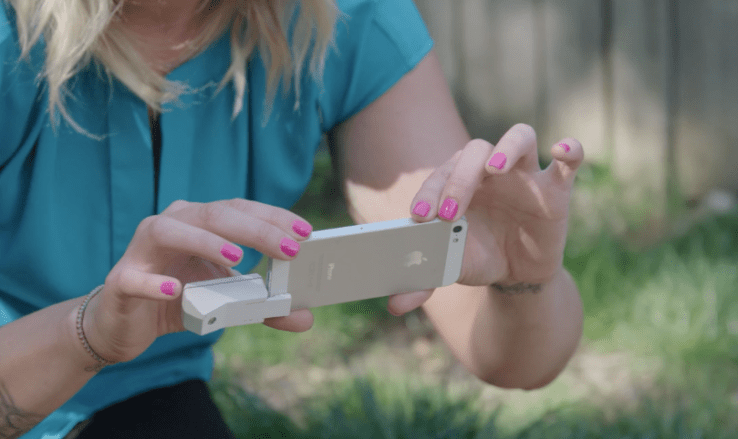
Canadian company Matter and Form is aiming to change this with Bevel, a device that plugs into your phone’s audio jack and allows it to capture 3D photographs. The device is currently in the midst of a $200,000 Kickstarter campaign, and eventually will retail for $49.
Bevel uses an eye-safe laser that acts as a fixed light source to capture scale and geometric detail, while your phone’s camera captures color, texture and other details. The result is a 360-degree model that you can rotate, zoom and even 3D-print.

Laura-final
Notably, the device and software will also work across a variety of phones and platforms, since it will ship with a calibration card that will help it adjust for various phone sizes and headphone jack locations.
Bevel will also come with a companion app, which will allow users to capture and share these 3D models.
While the company said these captured images will probably be saved in a proprietary format, the app will allow them to be exportable in common 3D formats so they can be printed or imported into other software.
Matter and Form is also launching Cashew, which is the company’s new (still in beta) online platform to upload and share 3D content.
While Cashew is similar to existing services like Sketchfab, users should benefit from the easy ability to upload to Cashew directly from the Bevel app. Cashew will also allow users to send models directly to 3D printing services like Shapeways.
Matter and Form already has experience launching 3D hardware products. Last year, they launched a relatively affordable 3D scanner, which we took a look at in a hands-on review. Now, the company is bringing 3D scanning to the masses, with the very affordably priced Bevel.
The company’s end goal is to allow users to create and consume 3D media “without all of the BS that comes with traditional 3D software and programs.” Drew Cox, founder and CEO of Matter and Form, emphasized that most hardware and software in the 3D ecosystem was developed a long time ago, and isn’t very intuitive.
The devices are expected to ship late Q4/early Q1 2016 and can be preordered on Kickstarter now.

Comments

Popular posts from this blog

How Education Will Be Smarter, Less Intrusive, And Able To Respond To How You Feel

Impatience characterizes the technology sector’s approach to education. Disruption is taking place in all other sectors of society — so, why not education? I know too well, whether at Pearson or in the classroom, the challenges and frustration of developing and using digital tools that improve outcomes for students. But I’m optimistic. We are on the verge of a tide of smarter innovation that, if allowed to spread, will turbocharge the learning experience for students. Here are four areas worth watching: 1. Using technology to learn from learners Every great digital product constantly evolves by learning from its users, adding capabilities, and improving its performance. If it’s true for your Facebook feed, then why not education? The potential is there, as the OECD’s recent report on  Students, Computers and Learning  (OECD) incidentally showed how clickstream and tracking navigation in digital readers can be used to see how students process online text and...

Top 20 WordPress Interview Questions and Answers

Top 40 WordPress Interview Questions and Answers  for freshers and experienced are below are below : 1. What is WordPress? WordPress is an online, open source website creation tool written in PHP. But in non-geek speak, it's probably the easiest and most powerful blogging and website content management system (or CMS) in existence today. 2. Different between WordPress.com vs WordPress.org? WordPress.com (fully hosted) Focus on your beautiful content, and let us handle the rest. WordPress.org (self-hosted) Get your hands dirty, and host your website yourself. refer official URL: https://en.support.wordpress.com/com-vs-org/ for more details. 3. Use of WordPress? WordPress is a free and open-source blogging tool and a content management system (CMS) based on PHP and MySQL. Features include a plugin architecture and a template system. WordPress was used by more than 23.3% of the top 10 million websites as of January 2015 4. feature of WordPress? Here are some of the featu...

IT Where

#Responsive_Webdesign  start from #7500, #hosting_Service  Start from #3300 Per Year #get   #your   #special  offers at  Itwhere Pondy #Digital_Marketing  , #SEO , #Product_Branding  at Itwhere Pondy Email:info@itwheretech.co. in M:+91 9092734853 www.itwheretech.co.in

Phoenix OS is (another) Android-as-a-desktop

Google Android may have been developed as a smartphone operating system (and later ported to tablets, TVs, watches, and other platforms), but over the past few years we’ve seen a number of attempts to turn it into a desktop operating system. One of the most successful has been  Remix OS , which gives Android a taskbar, start menu, and an excellent window management system. The Remix OS team has also generated a lot of buzz over the past year, and this week the operating system gained a lot of new alpha testers thanks to a  downloadable version of Remix OS  that you can run on many recent desktop or notebook computers. But Remix OS isn’t the only game in town.  Phoenix OS  is another Android-as-desktop operating system, and while it’s still pretty rough around the edges, there are a few features that could make it a better option for some testers. Some background I first discovered Phoenix OS from  a post in the Remix OS Google Group , altho...

Google Announces Android Wear Update With WiFi Support, Always-On Apps, And More

It has been a while since Android Wear got any substantial updates, but today Google is announcing a big one. A new version of Wear will be rolling out over the coming weeks that includes a number of previously rumored features (like WiFi support) and some all new stuff (like always-on apps). Most Wear devices use the always-on ambient mode for the watch face by default, the Moto 360 being a notable exception. The new Android Wear version allows apps to operate in ambient mode too, so they remain active when the watch goes to sleep. That makes it easier to take a quick glance at the app instead of waking the device up and opening the app all over again. The watch will still only go into full-color mode when necessary. WiFi support is also coming in the update, which means your watch can be useful even if your phone isn't connected. Watches with WiFi support will be able to connect to WiFi and still get messages and notifications from your phone, provided it has an interne...