Google Announces “Purchases On Google” For Buying Straight From PLAs And Other Mobile Shopping Updates

l i g h t p o e t / Shutterstock.com

The much-anticipated buy button in Google search ads is finally here. Called Purchases On Google, it turns out the new feature isn’t a button at all.
“Buy on Google” messaging will appear in eligible product listing ads on both iOS and Android smartphones. Purchases on Google is launching in a very limited pilot with select retailers.
When consumers click on Purchases On Google-enabled ads, they’ll be taken to a page hosted by Google where they can make a purchase using payment criteria stored with Google. The orders are then passed through to the retailer for fulfillment and any customer service follow up.
Check out our full coverage  where you’ll find many more details about Purchases On Google on our sister site Marketing Land.
Google also announced several of other updates to mobile PLAs:

New Mobile Shopping Ad Formats For Voice Search

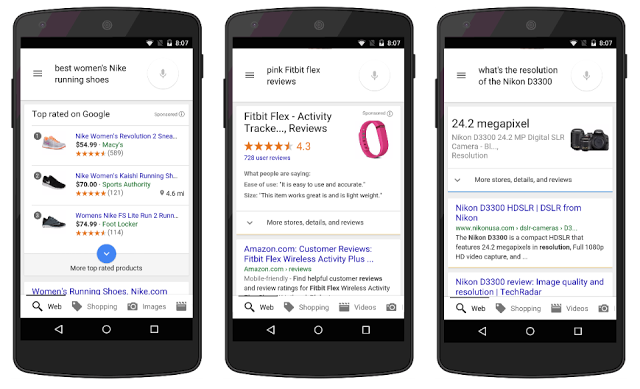
When consumers use voice search to find products, Google is starting to show new ad formats that include rankings and ratings In the left image in the screenshot below, you’ll see that the products are ranked 1 through 3, for example.
Google says click-through rates have increased up to 11 percent for retailers on these types of voice search product queries.
new google shopping for mobile ads

New product review cards and product attribute cards can show product ratings and snippets from “the most useful reviews from around the web” and details about a product’s features — similar to what Google has been doing in knowledge panel results.

Expanded PLAs When Viewing The Carousel On Mobile

When users swipe to see more in the PLAs on their smartphones, Google will now expand the ads to show the full product title and extensions like product ratings and nearby availability.
The functionality will roll out on Chrome for Android this month and come to iOS “in the coming months”.

Google Now In-store Cards

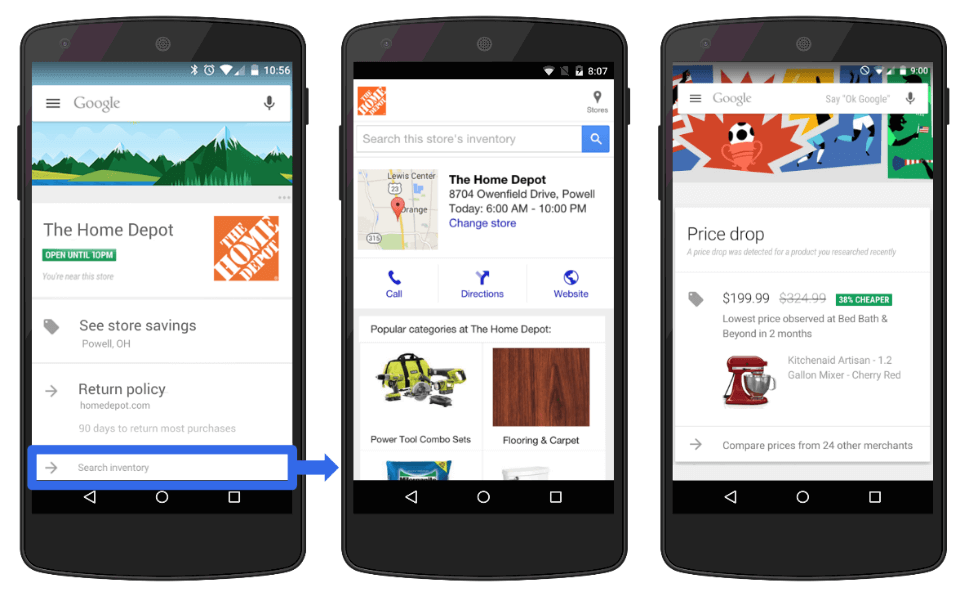
Among the announcements, Google said that Local Inventory Ads have been performing well and that many more will begin showing in mobile search results. In addition, now when a user is near a store, a Google Now in-store card may appear, showing sales, closing hours, loyalty card information and more. A link to “Search store inventory” takes users to the retailer-branded local storefront hosted by Google.
Also, on Google Now is a price drop card which will showcase a significant price decrease on a product the user has already browsed.

google now in-store cardsPLA Deep Linking To Shopping Apps

Google is piloting a test with a small set of global retailers, including eBay, Flipkart and Zalando to deep link their product listing ads to product pages in their apps instead of their websites.
Google says more retailers will be participating in the test in the next few months. Yesterday, the company also added the ability to measure conversion activity from clicks on display ads across apps and the web.

Comments

Popular posts from this blog

How ad-free subscriptions could solve Facebook

At the core of Facebook’s “well-being” problem is that its business is directly coupled with total time spent on its apps. The more hours you pass on the social network, the more ads you see and click, the more money it earns. That puts its plan to make using Facebook healthier at odds with its finances, restricting how far it’s willing to go to protect us from the harms of over use. The advertising-supported model comes with some big benefits, though. Facebook CEO Mark Zuckerberg has repeatedly said that “We will always keep Facebook a free service for everyone.” Ads lets Facebook remain free for those who don’t want to pay, and more importantly, for those around the world who couldn’t afford to. Ads pay for Facebook to keep the lights on, research and develop new technologies, and profit handsomely in a way that attracts top talent and further investment. More affluent users with more buying power in markets like the US, UK, and Canada command higher ad prices, effectively...

Facebook ‘Class Action’ Privacy Lawsuit Moves To Austrian Supreme Court

A privacy lawsuit filed against Facebook last year by Viennese lawyer and data privacy activist Max Schrems has moved up to Austria’s Supreme Court which will rule on whether the suit can be treated as a class action. When Schrems kicked off the suit, back in July 2014, he invited adult non-commercial Facebook users located anywhere outside the U.S. and Canada to join the suit for free — and tens of thousands of people quickly took up the invitation. The legal action focuses on multiple areas where the plaintiffs argue Facebook has been violating EU data protection laws, such as the absence of effective consent to many types of data use; the tracking of Internet users through external websites; and the monitoring and analysis of users via big data systems. Facebook’s participation in the NSA’s PRISM surveillance program is also part of the complaint. In July the case suffered a setback when an Austrian regional co...

Best Web Design Company in Pondicherry

#Technology    has two faces. We all feel it, but sometimes can’t find words to describe it.  #Ebooks    are the best example to show the 0-1 nature of emotions the  #technology  evokes. #itwhere    provide a  #Best     #solutions    to  #Growyourbusiness    feel free to drop a  #Mail    info@itwheretech.co.in www.itwheretech.co.in 

The EHang 184 Is A Human-Sized Drone Taking Off At CES

We’ve seen some pretty cool stuff on day 1 of CES 2016, but probably nothing more eye-catching than the EHang 184, a human-sized drone built by the Chinese UAV company  EHang . Yes you heard right — a giant autonomous drone that fits a human. It’s basically what you would expect to see if someone shrunk you down to the size of a LEGO and stuck you next to a DJI Inspire. Except no one was shrunk, and the giant flying machine was sitting smack in the middle of the CES drone section. EHang, which was founded in 2014 and has raised about $50M in venture fundingto date, was pretty gung-ho about telling everyone at CES that the 184 was the future of personal transport. And for the most part, people were too in awe to question them. But the reality is that the company probably was using the 184 as more of a marketing tool for their standard-sized drones like the  Ghost . Not that we’re saying that the 184 will never be a real thing, just that it probably isn’t co...