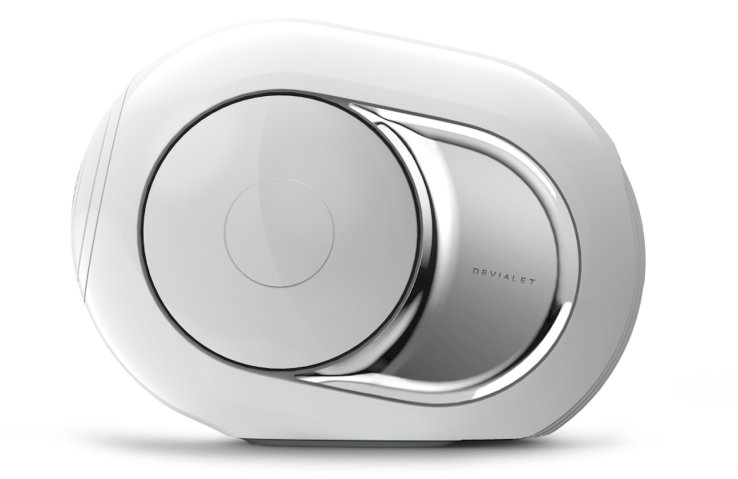
Phantom Speaker Maker Devialet Turns Up The Volume With New $20 Million Funding Round


Devialet, known for its Phantom speaker which supposedly sounds better than speakers 20 times bigger, just announced that it has closed a $20 million Series B round. LVMH CEO Bernard Arnault, Xaviel Niel, Jacques-Antoine Granjon, and Marc Simoncini are behind today’s funding round.
This funding follows a Series A in 2012 where the company raised $19.1 million to fund the development of the original Phantom Speaker, which Devialet said had a $30M R&D budget.
The Phantom was one of the stars of this year’s CES in Las Vegas. This compact speaker is much louder than all the other speakers that we saw at the show. From the other end of a crowded room, you could still hear the Phantom.
But the Phantom is also a different beast from your usual cheap Bluetooth speaker. Designed by a French team that has years of experience in the speaker and amplification industry, the company didn’t try to create yet another portable speaker. Instead, it went for the upper end of the market.
Priced at $2,000, this speaker isn’t for everyone. With this budget, you could get a speaker for every single room of a big house. But if you are serious about music, the company wants you to think that the Phantom is the speaker that you need. Devialet promises no distorsion or saturation — we didn’t get a chance to try this speaker in a quiet room, so you will have to take all of this with a grain of salt.
The company doesn’t want to be just a CES media darling anymore, and is ready to expand to the U.S. With at least $20 million in the bank, Devialet should be able to get the word out among American audiophiles.
And of course, Devialet is also thinking about its next product already. The company also announced today that it will introduce a new product, the Phantom Implosive Sound Center. Shipping this summer, the new hyperbolically named device could be powerful enough to replace all other audio components traditionally needed for a proper audio setup.

Comments

Popular posts from this blog

Facebook Now Supports PGP To Send You Encrypted Emails

You can now instruct Facebook to encrypt every email it sends to you so nobody — not even the NSA — is likely to be able to read your messages anytime soon. All you have to do is import your public PGP key into your Facebook settings and you’re good to go. The problem here, of course, is that most people have no idea how public/private key email encryption works and how to even get started with it. In the wake of Edward Snowden’s leaks, a number of organizations, including Google, promised to completely hide the complexities of end-to-end email encryption from regular users. Very few of these products have materialized so far, however — not for lack of trying, but because this is actually a very complex problem, both from a technical and user experience perspective. Facebook uses the well-established PGP scheme (the GNU Privacy Guard implementation of  OpenPGP, to be precise) to encrypt messages and tools lik...

What is your preferred smartphone screen size

Screen envy. We all have it. Or do we? See, that’s the thing, I’m just not so sure. One thing I am sure about is that our phone screens have gotten progressively bigger and bigger over the last few years. The funny thing is, we as a society have taken that ball and run with it, like we just don’t care. But I always thought we did care? Some time ago, when phones were in the sub-5” range, we used to have a term called “phablet” which described an almost absurdly big phone. The definition varied from person to person. I always considered a phone with a screen 5.5” or bigger to be a phablet. The Galaxy Note fell into that category. The Lumia 1520 certainly did. There are others as well. I was safely ensconced in the 4.5” area at the time with my Lumia 920. What did I know? Leon’s getting laaaaaaaarrrger But slowly, phones started topping the 5” mark. I’m not talking about phablets here, I’m talking about normal flagship phones – the Galaxy S4 (barely) and the HTC One (M7) are ...

Best Web Design Company in Pondicherry

#Technology    has two faces. We all feel it, but sometimes can’t find words to describe it.  #Ebooks    are the best example to show the 0-1 nature of emotions the  #technology  evokes. #itwhere    provide a  #Best     #solutions    to  #Growyourbusiness    feel free to drop a  #Mail    info@itwheretech.co.in www.itwheretech.co.in 

eGym raises $45M Series C for cloud-connected gym equipment and fitness software

eGym , the Munich-based startup that offers cloud-connected gym equipment and supporting cloud software and app for the fitness training floor, has closed $45 million in Series C funding. The round was led by new investor HPE Growth Capital, while existing investors, including Highland Europe, also participated. The problem that eGym is looking to solve is that, whilst gyms have moved from a bodybuilder market to a mass market in the last 20 years, the technology in gyms lags behind. That’s despite the fact that better use of technology can help to reduce customer churn, the biggest pain-point of both gym operator and gym users. Comprising of an app for both gym user and trainer, combined with the company’s connected strength machines, the eGym Cloud makes it possible for gym members to receive better fitness instruction and an evolving and personalised fitness plan based on data collected as they workout. And by providing a better workout feedback loop, gym goers can get an i...

Lumia sales are in the toilet, Surface revenue is down

Microsoft has just released its Q1 FY2016 (Q3 CY2015) earnings report, posting revenue of $20.4 billion, operating income of $5.8 billion, net income of $4.6 billion and earnings per share of $0.57 (all GAAP figures). The software giant's numbers beat analysts' expectations, which has added around 10 percent to its stock price in after-hours trading. Here are the highlights of the software giant's quarter. Microsoft has divided its earnings in three categories, namely Productivity and Business Processes, Intelligent Cloud, and More Personal Computing. The good news comes from Intelligent Cloud, where revenue is up by eight percent, while the bad news is in More Personal Computing, where the poor performance of Lumia and Surface devices lead to a 17 percent decrease in revenue, year-over-year. Revenue from devices decreased by $1.8 billion -- or 49 percent, year-over-year -- thanks to a decrease of $1.5 billion in Phones revenue and a further $236 million in Surface ...